What is a slipped back?
Lumbar misalignment is a disease of the spine that occurs when one of the bones of the spine is displaced backwards or forwards relative to the other. Slipped discs may be congenital or may develop as a result of age-related degeneration, trauma, uncontrolled falls or repetitive strain.
Brain and Neurosurgery Specialist Selçuk Göçmen states that slipped back can occur congenitally in childhood and for more degenerative reasons in older ages. He states that slipped back is more common in athletes, especially those who are engaged in branches such as gymnastics and weightlifting.
Is there a non-surgical treatment for slipped discs?
Non-surgical treatments can be applied depending on the degree of slipped back and the patient's complaints. Selçuk Göçmen states that rest, painkillers and anti-inflammatory medications, restriction of daily activities and, if necessary, the use of a lumbar corset can be beneficial in mild lumbar slippage.
Strengthening the muscles in the lumbar region through physical therapy and rehabilitation programs can contribute to the reduction of pain. It is stated that epidural or foraminal injections administered by the algology bölümü can be added to the treatment in patients with pain radiating to the leg along with low back pain.
How to make a definitive diagnosis
The diagnosis of a slipped back is made after an examination by a neurosurgeon or a physical therapy and rehabilitation specialist. X-rays, tomography and magnetic resonance imaging are used to clarify the diagnosis.
Selçuk Göçmen emphasizes that MR imaging is of great importance, especially to assess the degree of slipped back and the pressure on the nerves. When necessary, the degree of slippage can be revealed more clearly with moving radiographs.
In which patients should surgical treatment be performed?
Surgical treatment may be considered in patients whose symptoms do not improve despite treatment with medication, physical therapy and algology. Selçuk Göçmen states that in surgical treatment, the nerves in the spinal canal are relieved and the progression of the disease is stopped by fixing the slipped vertebrae.
In surgical treatment, the vertebrae are fixed with screw and plate systems to stabilize the spine. Füzion can be applied to the spine when necessary.
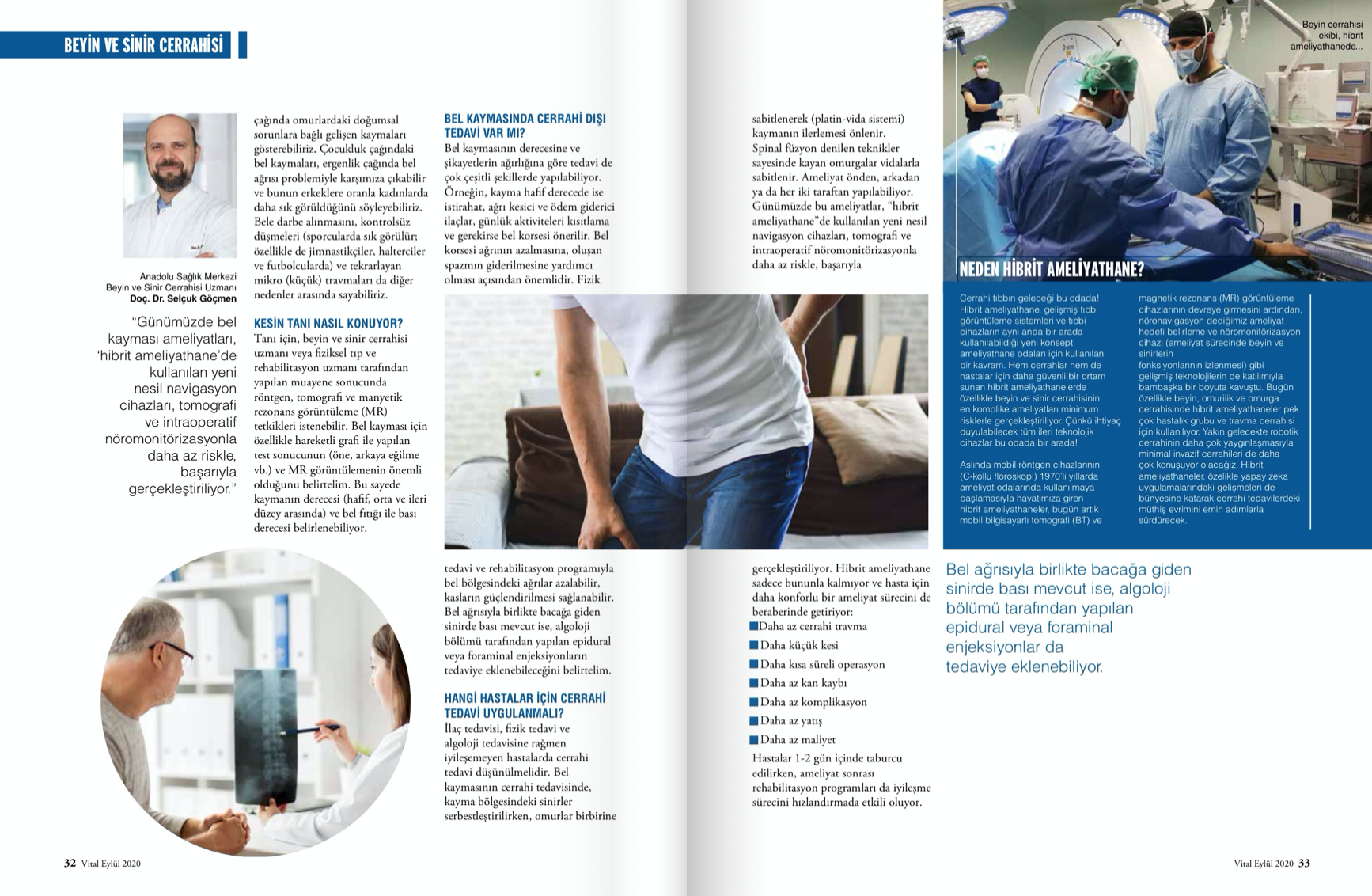
What is a hybrid operating room?
The hybrid operating room is a modern operating room system that allows advanced surveillance technologies to be used in the same environment during surgical procedures. Selçuk Göçmen states that new generation navigation devices, tomography and intraoperative nöromonitörization systems are used together in hybrid operating rooms.
This allows the surgery to be performed in a safer, more precise and more controlled manner.
Advantages of the hybrid operating room
Operations performed using a hybrid operating room:
-
Less surgical trauma
-
Lighter cuts
-
Shorter operation time
-
Less blood loss
-
Lower risk of complications
-
Shorter hospital stay
-
Faster recovery process
can be provided.
Post-operative rehabilitation programs are also said to accelerate the recovery process. It is stated that most patients can be discharged in 1–2 days.