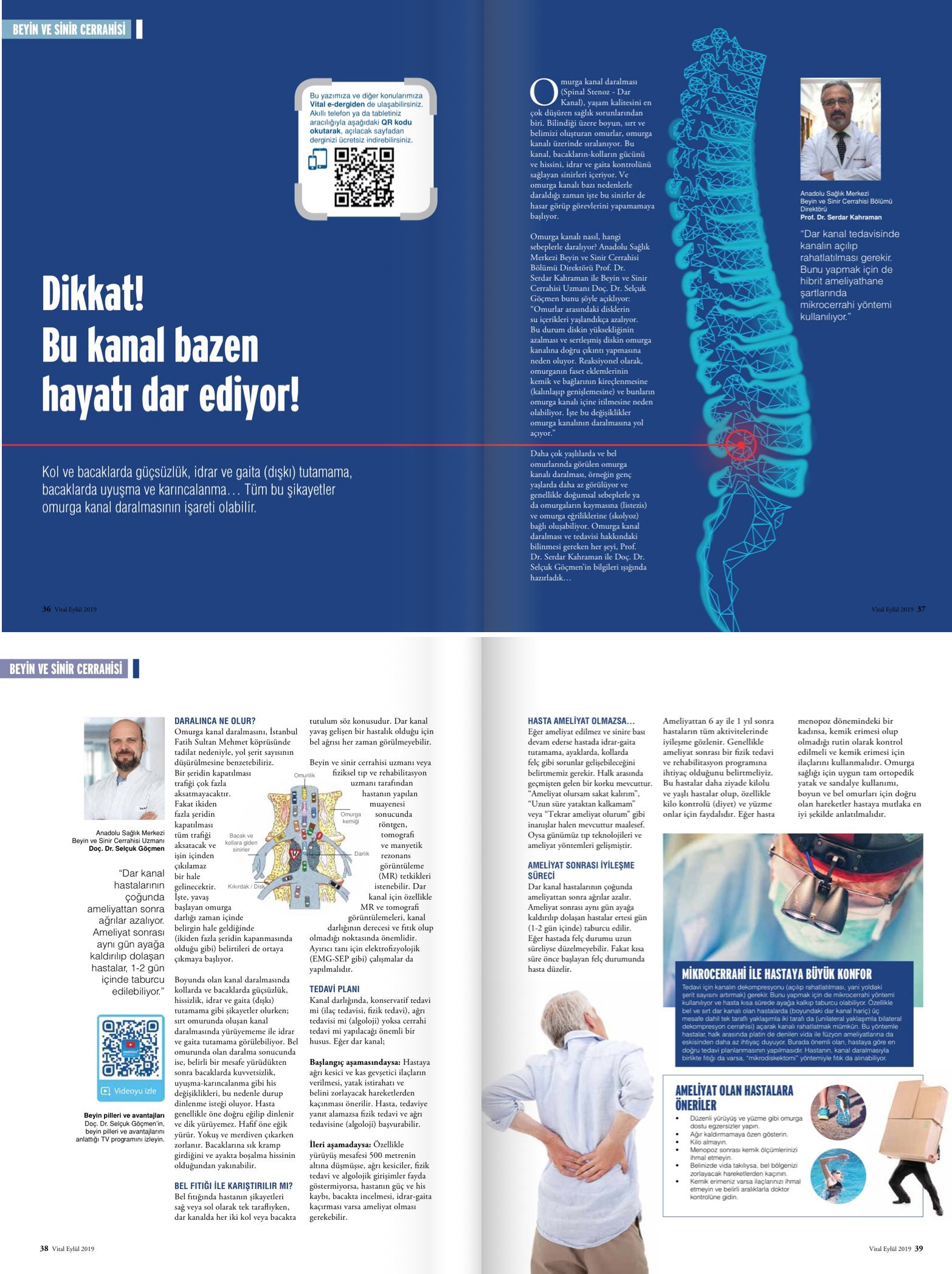
CENTAL AND NERVOUS SURGERY
What is narrow duct disease?
Spinal canal stenosis is a disease that occurs when the canal through which the nerves pass through the spine is narrowed for various reasons. This can be likened to the narrowing of traffic in a city. The closure of a single lane may not cause a major problem, but the closure of two or more lanes can seriously disrupt traffic.
Similarly, in narrow canal disease, the symptoms increase as the area through which the nerves pass narrows. The disease progresses slowly and low back pain may not always be apparent at the onset.
What are the symptoms of a narrow canal?
The most common symptoms in narrow canal patients are:
-
Pain in the lower back, legs and buttocks
-
Significant shortening of the walking distance
-
Numbness and weakness in the legs
-
Difficulty standing
-
Öne feeling of relaxation when bending over
-
Pain that increases with prolonged standing
In the case of canal stenosis in the cervical region, numbness in the arms, visual impairment, difficulty in fine motor movements and balance problems may occur.
Is it confused with a herniated disc?
In herniated discs, the symptoms are usually unilateral. In narrow canal disease, however, complaints can occur in both legs. In addition, pain in the narrow canal increases with walking and decreases at rest. This feature is important in differential diagnosis.
How is the diagnosis made?
The diagnosis begins with an examination by a neurosurgeon. When necessary, X-ray, computed tomography and magnetic resonance imaging (MRI) are used. An MRI scan clearly shows the degree of canal stenosis and the pressure on the nerves. Electrophysiologic tests such as EMG may also be ordered in some patients.
How is the treatment plan determined?
Treatment is planned according to the severity of the disease and its impact on the patient's quality of life.
Beginningç phase:
-
Painkillers and muscle relaxants
-
Physical therapy
-
Reorganization of daily activities
-
Waist corset can be worn
Advanced stage:
-
If the walking distance is severely shortened
-
Güç loss and increased numbness
-
If loss of control of urine or stool has begun
surgical treatment is indicated.
What happens if the patient does not have surgery?
Untreated, a narrow canal can progress. The walking distance becomes shorter and shorter, and patients may become unable to stand. In advanced cases, permanent nerve damage and paralysis may occur. Therefore, instead of being afraid of surgery, it is important to intervene at the right time.
Postoperative recovery
After narrow canal surgery, pain is significantly reduced in the majority of patients. Patients are usually up and about in 1 to 2 days and discharged in a short time. Physical therapy and rehabilitation accelerates recovery.
Microsurgery provides the patient with great comfort
Nowadays, microsurgical techniques are used in narrow canal surgeries. With this method:
-
More incisions are made
-
Less tissue damage
-
Blood loss is reduced
-
Shorter recovery time
-
Patients are discharged in a shorter time
Microsurgery allows the patient to return to their daily life faster.
Help for patients undergoing surgery
-
Exercise regularly, such as walking and swimming
-
Avoid sudden and heavy lifting
-
Do not stay in the same position for a long time
-
To lose those extra pounds
-
Do not neglect exercises that strengthen the back and back muscles
-
Maintain regular checkups
If you want, buddy:
-
A short version (card / teaser)
-
SEO-friendly header–spot
-
Landing page için simplified version
-
Or I can make the EN version in exactly this format.
If you're ready see next, let's continue.